
2024
Tianyu Yu, Xuezhu Wang*, Yao Lu*(equally contribute), Kejin Yu, Xiwen Yao, Wenjing Deng, Zhiyu Li, Xueqing Li, Xiao Xue, Yue Yang, Yijie Guo, Yuan Yao, Guanhong Liu, Haipeng Mi
Smart materials have garnered significant attention in both academia and industry, yet identifying pragmatically impactful applications still requires contributions from multiple stakeholders, including researchers, designers, and industry professionals. Although previous research has explored novel technical approaches or user-centered applications of smart materials, this study focuses on how to stimulate effective dialogue among stakeholders to explore impactful smart material applications.
To this end, we provided a card-based co-design toolkit, tailored to automotive interior design as a case study. We conducted a multi-stakeholder co-design workshop to examine the performance and reveal the benefits of employing the toolkit in the co-design process. The workshops resulted in 16 concept designs. Qualitative interviews further revealed that, using our toolkit, the co-design process effectively fostered mutual understanding among stakeholders, enhanced both creativity and depth throughout the design process, and provided practical insights for each stakeholder’s future work.
Contributions:
- Led the project, collaborate on the card-based toolkit and workshop, lead the interview and analysis sessions.
The Multistakeholders in the Case of Automotive Interior Design
The innovation of automotive interior design is a trending topic for both academia and industry. The emergence of advanced hardware and materials has blurred the boundaries between interior design and in-vehicle interfaces, making the automotive interior design a typical scenario for employing the multi-stakeholder co-design method to explore the smart material applications with pragmatic insights. Therefore, we selected automotive interior design as a case in this study and used it to examine the co-design toolkit we proposed through a multi-stakeholder co-design workshop.
After a pilot study with a focus group involving both the core members from our research team (including technical and design researchers), as well as a specific industry team from a leading automotive brand, focusing on automotive interior design, we identified three primary stakeholders in this study: technical researchers, interaction designers, and specific industry teams, along with their roles that might be essential and irreplaceable within the co-design process.

The three co-desgin stakeholders in this case study on automotive interior design
Technical Researchers
In co-design, they play a crucial role as providers of technological expertise, offering guidance and solutions. With their extensive knowledge of smart materials, such as the functionality or engineering properties of the smart material, they are able to recommend suitable technologies that align with design requirements while addressing technical constraints. Their expected contributions include:
- Technical knowledge: What are the key functions and mechanisms of each material technology? What critical engineering parameters need to be considered?
- Application space: What are the potential use cases for each technology? Which technology is the best fit for the proposed design objective?
Interaction Designers
Interaction designers contribute to design critique and delivery. With their expertise in user-centered perspectives, they clarify the design goals with a deep consideration of user needs or other human-centered factors. They are also skilled at balancing conflicting conditions and matching design objectives with practical solutions, finally refining the delivering the design outcome. Their expected concerns include:
- User perspectives: How might users perceive and evaluate the design?
- Design critique: Does the design align with or challenge relevant social and cultural contexts?
- Design delivery: How can the design be effectively articulated and presented?
Specific Industry team
They play an important role in offering pragmatic insights and being responsible for driving the designs to real-world products. With a deep understanding of market trends, customer needs, brand identities, and engineering solutions, the industry team helps ground the design process in a real-world context. Their expected concerns include:
- Brand identity: Does the design reflect the company’s values and identity?
- User benefits: What advantages does the design offer to users?
- Product commercialization: How viable is it to bring the design to market?
- Engineering feasibility: How feasible is the design from an engineering perspective?
A Card-based Toolkit
We introduced the card-based toolkit tailored for the co-design process of smart material applications in automotive interiors, involving multiple stakeholders of technical researchers, interaction designers, and the industry team. The card-based toolkit includes: (a) Objective Card Set, (b) Technology Card Set, (c) Evaluation Card, (d) Interior Layout Board, and (e) Evaluation Board. Each card set is provided with multiple keywords or items for using. A full-set printed version of our card toolkit could be downloaded from this Supplemental Material A.
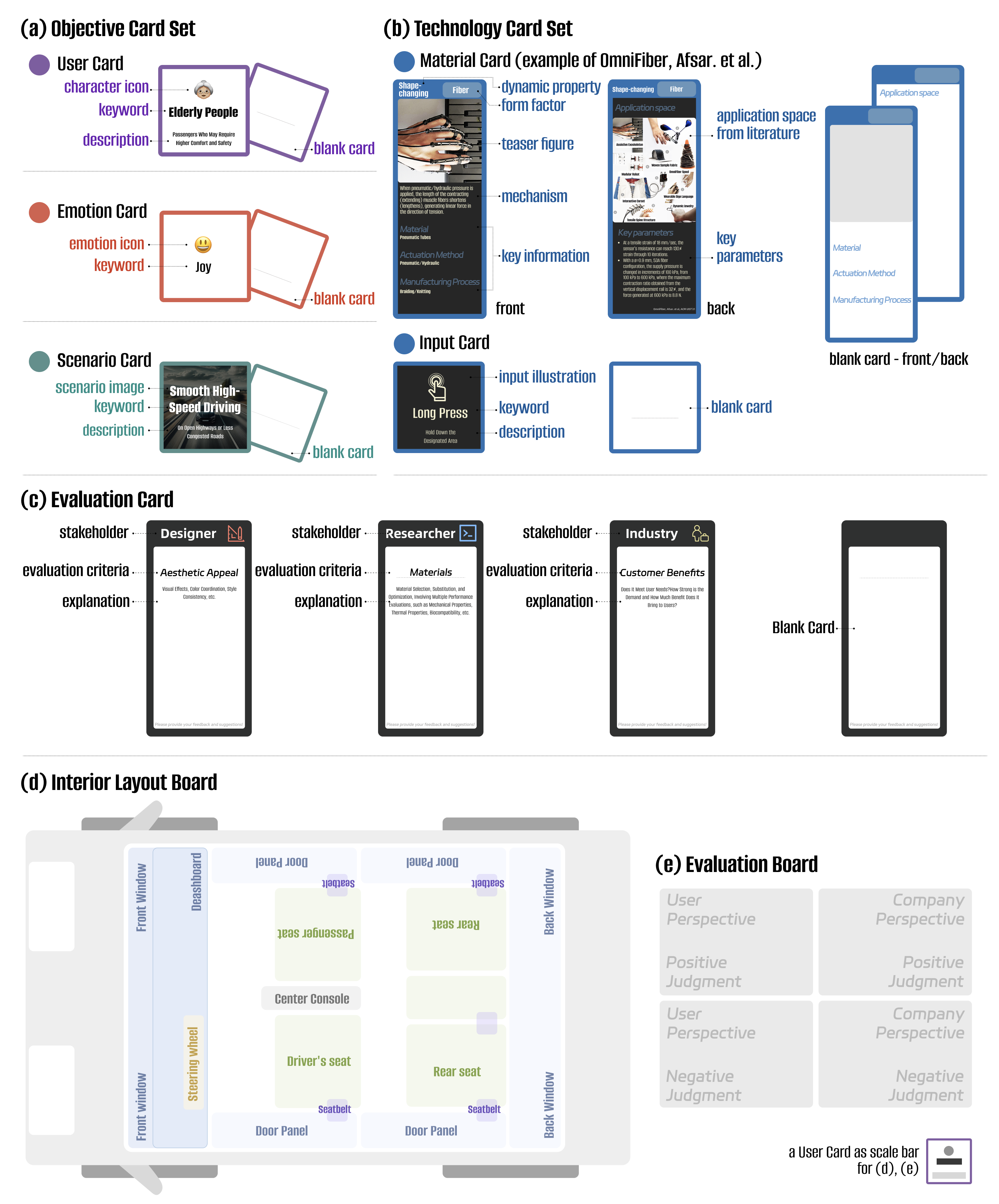
The card-based co-design toolkit for exploring smart material applications
Material Card
We highlighted our Material Card in the Technology Card Set, where we selected the technologies from recent HCI or material science research that focus on advanced materials or devices, capable of providing programmable output physical properties. To support participants in understanding and choosing the appropriate smart material technology in the co-design process, we formed a two-dimensional material palette, shown in the following figure. We populated this palette with examples from academic research that fit each category, resulting in a total of 17 representative smart material technologies. Note that we left two categories in the palette (temperature-changing fiber & 3D structure) blank, considering their relatively low practicality in real applications. We are also open to extending the palette dimensions when more smart materials might be considered in future work.

The 2-dimensional material palette for Material Cards
Co-design Workshop
With the card-based co-design toolkit, we conducted a co-design workshop, centered on exploring pragmatically insightful applications of smart materials in automotive interiors, involving the three groups of stakeholders identified from the pilot study. The aim of the workshop is to examine the performance of the tailored co-design toolkit, as well as to reveal the benefits of employing the toolkit in exploring smart material applications.
We recruited 26 participants for the workshop. The participants included 5 technical researchers, consisting of local university students specializing in smart materials or general engineering fields; 11 interaction designers, consisting of university students with experience in interaction design, product design, or media arts; and 10 industry team members, specializing in interior innovation from a international automotive company, whose background ranging from innovation management, research & development and marketing & customers. Participants were divided into five groups based on their stakeholder role and professional background. Each group included one technical researcher, at least two designers, and at least one member of the industry team.
Procedure
The workshop is structured into several phases, designed to guide participants logically and smoothly through the co-design process, which also introduces the card-based toolkit at appropriate stages to ensure its optimal usage. Accordingly, we divided the workshop into four phases: (a) explanation, (b) design, (c) evaluation, and (d) summary, shown in the following figure.

Co-design workshop process with demonstration on how to use the card-based toolkit at different stages.
Design outcomes
After the workshop, we analyzed the design outcomes from all groups and focused on emerging insights or patterns that could be valuable for the scenario of automotive interior design. The analysis served as an examination of the effectiveness of the co-design process using the card-based toolkit. In total, the five teams generated 18 initial concept designs. After deconstructing and reorganizing these raw ideas, we ultimately structured 16 concept designs as the eventual outcomes. We then analyzed these concept designs through multiple approaches, including visualization, classification, and a rating procedure by the industry team. The full list of the 16 concept designs is documented in this Supplemental Material B.

Visualization of 16 concept design outcomes from the co-design workshop. R# – the index of each concept design.
Reflection on the Co-design Workshop
Post-wokshop Interview
After the workshop, we invited participants to engage in follow-up interviews to gather their evaluations and reflections on the co-design process, aiming to uncover the benefits of using our card-based toolkit during the multi-stakeholder co-design process. 20 of the 26 participants accepted the invitation. We conducted individual, semi-structured online interviews, each lasting approximately one hour.
The interviews were structured in threefold: (1) We first asked participants about their overall experience of the workshop, focusing on their interactions with multiple stakeholders and the role of the card-based toolkit in facilitating the process. (2) Next, we discussed the concept designs created by their group, asking participants to select their preferred design and explain their reasoning, while reflecting on the creative process. (3) Finally, we explored the perceived benefits of the workshop, memorable moments, how it differed from their usual design processes, key takeaways, and any identified limitations. During the interviews, we often referred to photos and videos of the participants’ work to facilitate discussion.
After the interview, we applied Reflexive Thematic Analysis to the interview content. During the analysis process, each interviewer from our research team first coded their own interview transcripts. Next, the first author applied a second round of coding to all the transcripts and then synthesized the key themes. After that, the first author discussed the results with other interviewers, refined the themes to finalize the results.
The findings from the interview include four themes:
- Engagement with the card-based toolkit: Like a game.
- Stimulating dialogue between multi-stakeholders: Who is talking?
- Enriching the co-design process: How to create?
- Pragmatic significance of the co-design process: Why it matters?

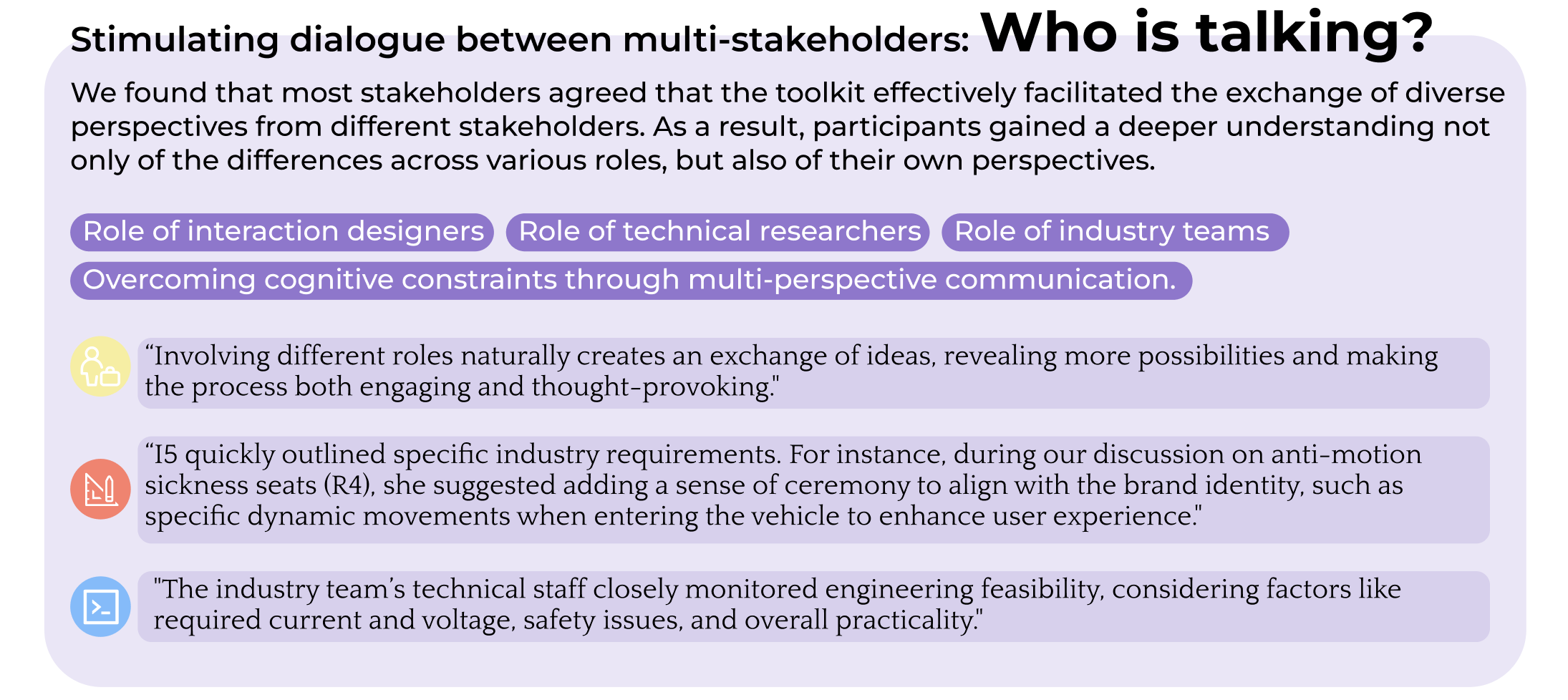
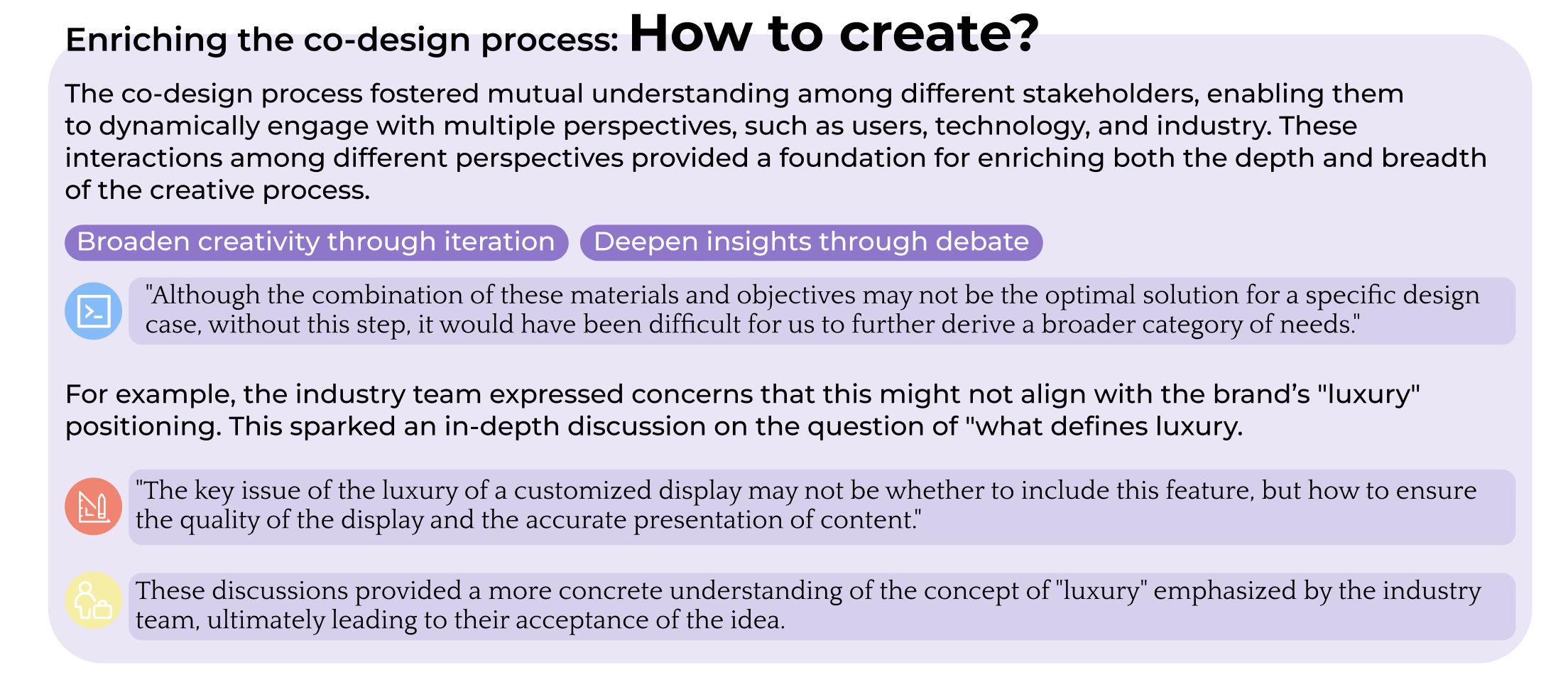


Highlights of the four themes emerged from the post-interview of the workshop, showing reflections on the experience and results using the co-design card-based toolkit.
Design chain stimulated by multiple stakeholders
From the post-workshop interviews, we observed interesting chain-like patterns emerging within the dialogue, which iteratively refined or reviewed a design ideation process, ultimately broadened the creative scope, and deepened pragmatic insights of the outcomes. We refer to these patterns as the “design chain”.
During the design phase, the “design chain” manifested as a chain-like dialogue pattern of “Objective-Solution-Objective”. For instance, stakeholders concerned with target users or scenarios would first propose a design objective. Subsequently, stakeholders specializing in providing solutions would lead the discussion, suggesting potential smart material techniques or design solutions. However, these proposed solutions did not necessarily conclude the design process; rather, they served as an inspiration, grounded in material functionalities, to guide other stakeholders in expanding upon new design objectives. These objectives have the potential to exceed expectations, offering leaps in creativity that are typically hard to achieve through conventional design processes. Examples could be found in the paper.
The “design chain” also appeared during the evaluation phase of the workshop, where it manifested as a chain-like dialogue pattern of “Judgment-Proposal-Judgment”. For instance, during the evaluation phase, one stakeholder (e.g., the industry team) would make a judgment on a concept design based on a specific concern (e.g., brand identity). However, rather than abandoning the idea, other stakeholders (e.g., designers) would lead the discussion and propose adjustments or compromises to optimize the concept design in response to the prior judgment. This process would continue for several rounds until a final concept design was delivered, with its value likely maximized through iterative refinement. Examples could be found in the paper.
These “design chains” are intriguing because they are inherently driven by iterative dialogue among different stakeholders, especially as the leading perspective continuously shifts. It is the revelation and interaction of multi-stakeholders’ concerns that fuel these design chains, leading to unexpected creativity or outcomes.
Gamified design of the cards
According to the interview, the card-based tool provided participants with a gamified experience, making the process enjoyable and enhancing their enthusiasm and engagement. We regard this gamification as one of the key advantages of physical cards, which should be considered as an intentional design feature when developing card tools.
Nevertheless, participants also pointed out several limitations of the cards used in this study, such as the large number of cards cluttering the workspace, making them difficult to read and handle. This feedback suggests exploring alternative card forms, such as digitizing the cards and using a “Palette” metaphor. In this approach, each type of card could be represented as a “Palette”, with users selecting and combining cards from different sets to create a concept design, similar to mixing colors from different palettes. This approach would potentially enhance the usability of the tool, particularly when working with numerous sets and items, while maintaining the gamified experience of the card-based tool.
Further detials: A Card-based Co-Design Toolkit for Exploring Smart Material Applications with Multiple Stakeholders: A Case Study on Automotive Interior Design (DIS ’25)
 Tianyu Yu